

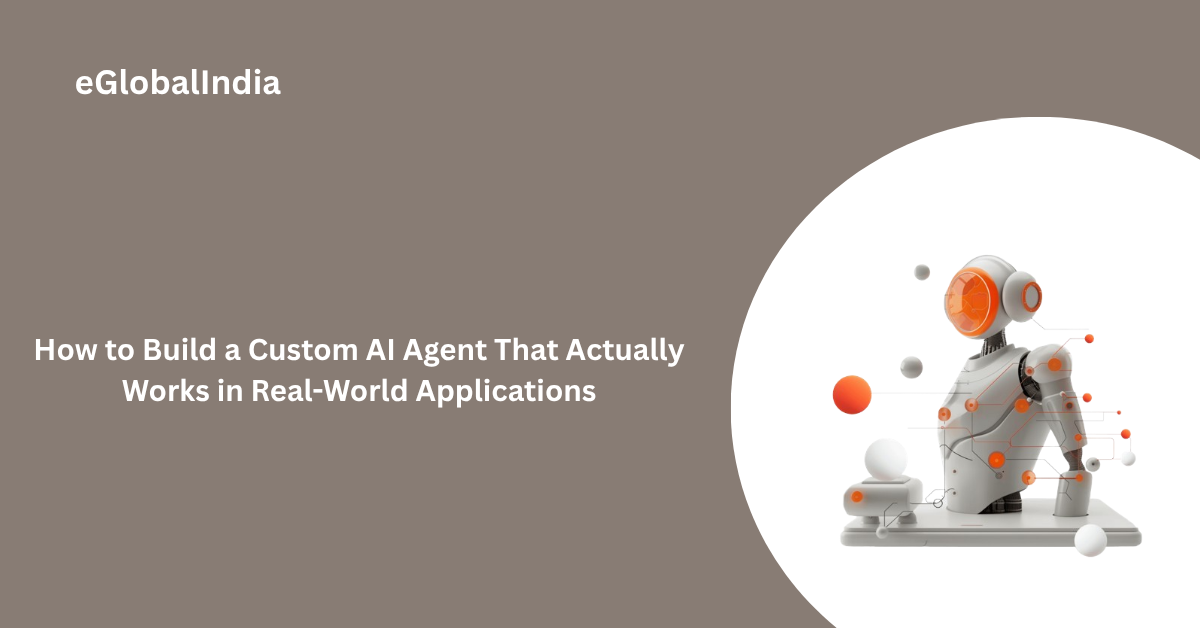
Most AI agents look great in demos – and fail in production. If you’ve tried to build a custom AI agent and hit a wall, you’re not alone. The gap between a “working prototype” and a real-world deployment is massive – and most tutorials skip right over it. In this guide, you’ll learn exactly how to build a custom AI agent that solves real business problems, runs reliably at scale, and doesn’t collapse the moment a user does something unexpected. Whether you’re partnering with an AI agent development company or building in-house, this is the practical blueprint you need.
A custom AI agent is an AI system built to perform specific tasks autonomously – using tools, APIs, and decision logic tailored to your business. Unlike generic chatbots, a custom agent can plan, act, and adapt based on real-world inputs. Generic AI tools are built for everyone, which means they’re optimized for no one. A custom AI agent is designed around your workflows, your data, and your goals. That specificity is what makes it actually useful.
Key differences from off-the-shelf AI:
• Trained or prompted on your domain-specific knowledge
• Connected to your internal tools and APIs
• Designed around your exact user journeys
• Measurable against your specific business KPIs
What Tools Do You Need to Build a Custom AI Agent?
You don’t need a massive tech stack to start. But you do need the right foundation. Here’s what most serious AI agent development teams use:
• LLM backbone: GPT-4 / Claude / Gemini for reasoning and language understanding
• Orchestration: LangChain, LlamaIndex, or AutoGen for managing agent logic
• Memory: Vector databases like Pinecone, Weaviate, or ChromaDB
• Tool use: APIs, web search, code execution, or custom functions
• Monitoring: LangSmith, Arize AI, or custom logging dashboards
• Deployment: FastAPI or serverless functions (AWS Lambda, Google Cloud Run)Pro
tip: Don’t over-engineer the stack early. Start with one LLM, one memory layer, and one or two tools. Complexity should grow with proven use cases.
Here’s the no-fluff process used by every serious AI agent development company:
Why Do Most AI Agents Fail in Real-World Use?
This is the question no one talks about enough. Most AI agent projects fail not because of bad AI — but because of bad architecture decisions and untested edge cases.
The most common failure reasons:
What Are the Real-World Use Cases for Custom AI Agents?
Real-world AI applications aren’t just hype. Here’s where companies are getting genuine ROI from agentic AI development services:
How Do You Deploy an AI Agent in Production?
Deployment is where most guides go quiet. Here’s what actually works in production AI systems:
• Wrap the agent in a stateless API (FastAPI or serverless) for horizontal scalability
• Use async queues (Celery, Redis) for long-running tasks — never block on agent responses • Set hard token and cost limits per session to prevent runaway API bills
• Implement structured output parsing — don’t trust the agent to always return valid JSON
• Add circuit breakers for external tool calls — if an API fails 3x, stop and alert
• Log every input, output, and tool call — this is your audit trail and your debug lifeline
• Run canary deployments before full rollout — test with 5–10% of real traffic first Working with an experienced AI agent development company can cut your deployment time by 60%+ by avoiding these common pitfalls from the start.
Building a custom AI agent that works in the real world is very doable — but it requires more than a good LLM and a few API calls. You need a clear use case, the right architecture, serious testing, and production-grade deployment practices. The companies winning with AI right now are the ones treating agent development like product development: iterative, user-driven, and obsessively measured. Whether you’re partnering with a top AI agent development company or building your own agentic AI development capabilities in-house — the fundamentals are the same. Define clearly. Build lean. Test hard. Monitor everything. The future belongs to businesses that move from AI experimentation to AI execution. Your next step is to pick one use case and start building
Aug 24, 2026

Aug 22, 2026

Aug 21, 2026

© 2017 All rights reserved.